
Amber and Resin: The Fragrance Pantry
A walk through the materials that give our candles their depth, and why the base note matters most.
Most people, asked to describe a scent, will reach for the top notes. They will say bergamot, or lemon, or pine. The base notes do the harder work, and they get less credit. We want to spend an essay correcting that, because almost everything that distinguishes a candle worth burning from a candle worth ignoring lives in the base.
A QUICK VOCABULARY
A fragrance is conventionally divided into three accords. Top notes are the volatile molecules that arrive first and disappear quickly: citrus oils, light herbs, certain greens. Heart notes are the floral and spice middle, the body of the scent. Base notes are the heavy, resinous, often animalic materials that linger for hours after the candle is extinguished. They are what your sweater smells like the next morning. The ratio between the three is what perfumers call the structure, and the structure is the thing that makes a scent feel composed rather than thrown together.
AMBER, WHICH IS NOT ONE THING
Amber, in perfumery, is rarely the fossilized resin you find in museum cases. It is an accord, a constructed family of materials that together produce a warm, slightly sweet, slightly powdery base. Labdanum, benzoin, vanilla, a touch of patchouli, sometimes a synthetic ambroxan to extend the trail. Each amber accord we use is built specifically for the candle it goes into. The amber in our brass piece is darker and more leathery. The amber in our porcelain piece is lighter, almost honeyed. Calling both of them amber on the label is true and also incomplete, which is part of why we describe scents in our listings the way we do, with full note pyramids rather than single-word categories.
RESINS, THE SLOW WORKERS
Frankincense, myrrh, benzoin, opoponax, labdanum. The resins are the oldest perfumery materials we know, and they remain the slowest. They are heavy molecules. They evaporate gradually, which is exactly what you want in a candle that will burn for forty hours. A scent built only on top notes goes flat after an hour. A scent built on a resinous base only deepens. Frankincense in particular has a quiet, almost lemon-edged quality at the start that opens into something dry and church-like over time. It is one of the hardest materials to use well because too much reads instantly as devotional, and we are making domestic objects, not liturgical ones.
THE ANIMAL QUESTION
Historic perfumery relied heavily on animal fixatives: ambergris, civet, castoreum, musk. We use none of them. Modern synthetic equivalents do the same fixative work without the ethical or supply-chain problems, and in candles specifically the synthetics actually perform better because they are more thermally stable. The molecule called ambroxan, derived originally from clary sage, is the workhorse of contemporary amber accords. It is what makes a modern amber smell warm and skin-like without ever having involved a sperm whale.
WOODS AND THE LONG TAIL
Sandalwood, cedar, vetiver, oud. The wood family overlaps with the resin family in function: both contribute to the long tail of a scent, the part that lingers. Sandalwood, especially Mysore sandalwood, has become nearly impossible to source ethically, and most of what is sold under that name today is either Australian sandalwood or a synthetic reconstruction. We use the Australian. Vetiver, the smoky grass root from Haiti and Indonesia, gives a candle a dry, earthy floor that grounds floral hearts beautifully.
WHY SOY LOVES A HEAVY BASE
Soy wax, as we have written elsewhere, releases scent at lower temperatures than paraffin. This is wonderful for delicate top notes, but it is even better for resins. The wax pool, hovering at around one hundred and fifty degrees Fahrenheit, gently lifts the heavy molecules without scorching them. The result is a throw that stays consistent from the first hour to the last, rather than blasting at the start and dwindling to nothing.
SOURCING
We buy our raw materials from three small houses in Grasse and one in Brooklyn. None of them are cheap. All of them will tell us, on request, exactly where a given resin was harvested and when. We pay for that traceability because we pour it into vessels that themselves have known provenance, and an honest vessel deserves an honest scent. We also test every new batch of fragrance oil in our standard wax base before approving it for production. A material that smelled wonderful on a blotter sometimes turns out to throw poorly in a candle, and we would rather discover that in the workshop than in your living room.
READING A CANDLE BACKWARDS
When you receive one of our candles, light it for an hour, then snuff it and walk away for ten minutes. Come back and smell the cold throw. That residual scent, the part still hanging in the room after the flame is out, is the base. It is the most honest part of the candle. It is also the part that will still be faintly present in your living room two days later, the way a guest you liked is still faintly present in the chair where they sat. If you love that residual smell, you have chosen well. If you don't, the candle was not for you, no matter how lovely the top was.
HOW WE BUILD A NEW SCENT
Designing a new scent for the workshop takes between four and six months. We start with the vessel. A specific brass cup, or a specific cut tumbler, will suggest a direction the moment we hold it. Warm, austere, dry, sweet, smoked. From there, we sketch a note pyramid on paper, order small samples of the materials we want to test, and build a base accord first. The base has to work in soy at our standard fragrance load, and it has to throw consistently from hour one through hour forty. Only after the base is stable do we add the heart, and only after the heart is stable do we add the top. Most candle companies build top-down because the top is what sells the candle on first sniff. We build bottom-up because the bottom is what makes the candle worth living with.
ON RESTRAINT
The single most useful skill in candle perfumery is leaving things out. A scent with eight notes, well chosen, will read as composed and intentional. The same scent with twelve notes will read as muddy. Every additional ingredient is also an additional risk: an additional source of batch variation, an additional possibility of degradation over cure time, an additional cost. We aim, always, for the smallest number of materials that will do the job. Restraint is also why our scent descriptions on each product page are short. If we cannot describe a scent in three lines, we have not finished designing it.
CLOSING
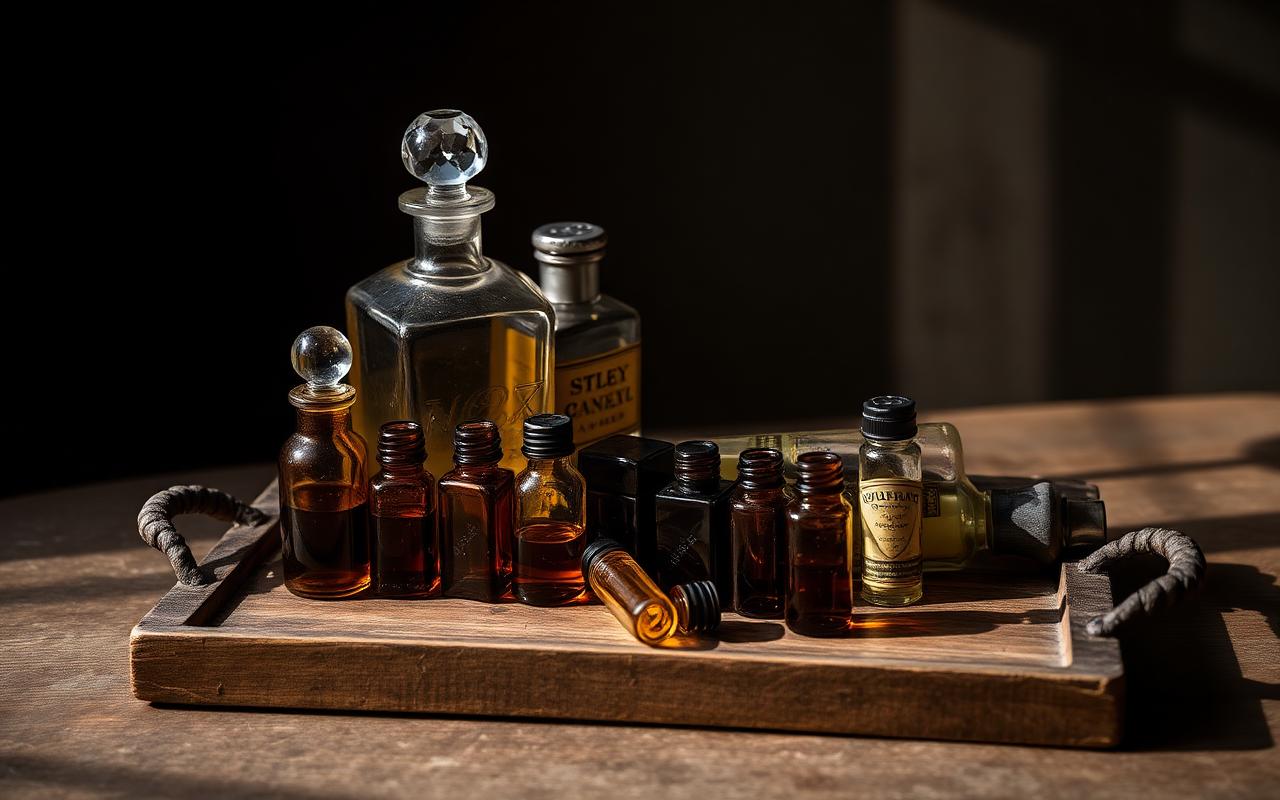
The fragrance pantry is the part of the workshop visitors never see. It lives in a cool, dark cabinet behind the pour station, in small amber bottles labeled with date and lot. Open the cabinet and you smell the whole library at once: resins, woods, spices, the faint citrus of bergamot leaking from a sealed bottle. It is, more than anywhere else in the workshop, the place where the candles are actually made. The pour is just where the work becomes visible.