
The Light Cut Glass Keeps
On crystal decanters, refracted candlelight, and why a hand-cut vessel never goes quiet.
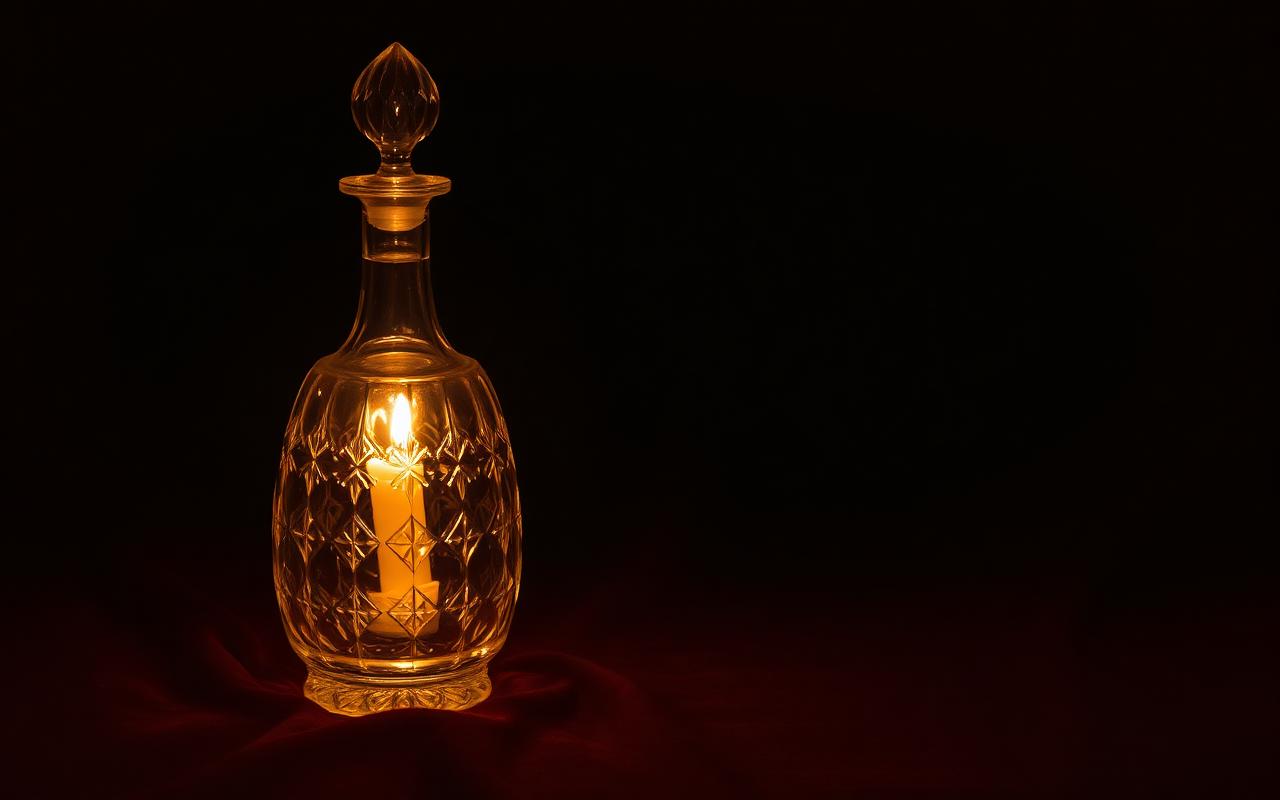
There is a particular hour, somewhere between dusk and full dark, when a cut-glass decanter on a sideboard stops being furniture and becomes weather. The room hasn't changed. The decanter hasn't moved. Only the light has shifted, and suddenly an object you walked past a hundred times this week is doing something you can't quite look away from. We've spent enough hours studying that exact transformation that we feel obligated, finally, to write something down about it.
A BRIEF HISTORY OF THE CUT
Crystal cutting as we recognize it today emerged in the late seventeenth century, when English glassmakers led by George Ravenscroft began adding lead oxide to their batches. The result was a softer, heavier glass that took a wheel beautifully and refracted light at sharper angles than ordinary soda-lime glass. By the Regency period, every house of any pretension owned at least one cut-glass decanter, and by the Victorian era the form had calcified into a vocabulary: diamond, fan, hobnail, strawberry, mitre, prism, step. Each pattern was a small grammar of light. Each angle, cut by hand against a spinning iron wheel charged with sand and water and then polished against a wooden lap with rottenstone, was an investment in refraction. The glass was not merely decorated. It was tuned, like a pipe organ, to the candles that would inevitably stand near it. Electric light was decades away. Every cut was made with an oil lamp or a wax taper in mind.
WHY REFRACTION IS NOT DECORATION
A flat surface reflects. A faceted surface refracts, and refraction is closer to music than to image. When you light a candle inside or beside a cut-crystal vessel, the flame is not duplicated. It is multiplied, fractured, scattered along axes the cutter chose decades or centuries before you were born. The wall behind your sideboard suddenly carries a constellation. The ceiling carries another. Move three inches and the pattern reorganizes itself. This is why a cut decanter, even empty, feels alive in candlelight in a way that a smooth one never does. The cutter was, in effect, composing for an instrument they would never play. You are the player. Every time you light a flame near the vessel, you complete a circuit they opened in 1840.
READING THE PATTERN
We've learned to read cut patterns the way a sommelier reads a label. Hobnail, with its raised diamond bosses, is almost always Anglo-Irish, often Waterford or one of its competitors, and almost always pre-1850 if the cutting is deep and crisp. Strawberry diamond, a finer cross-hatched pattern, signals a slightly later mid-Victorian piece. Step cutting, with its parallel horizontal grooves, came into fashion in the Edwardian period and tends to read more austere. Bohemian cutting often combined deep mitres with engraved botanical work and looks unmistakably Central European. None of this matters for whether a piece is beautiful. All of it matters for whether the price you're being asked to pay is honest.
CHOOSING THE VESSEL
When we evaluate a decanter for the workshop, we look first at the foot. A heavy, well-ground foot suggests the maker expected the piece to stand for a hundred years. We look next at the cuts themselves: are the mitres crisp, or have they softened with polish and time? A little softening is welcome. Industrial sharpness reads as new even when the piece is old. We avoid pieces with chemical bloom inside, the cloudy haze that comes from decades of port or whiskey left to evaporate. Bloom can sometimes be polished out with denture tablets and patience, but the glass is rarely the same afterward. We also avoid stoppers that have been ground to fit a body they were not born with. A married decanter is a fine practical object and a poor piece of furniture.
LIVING WITH ONE
A decanter does not have to hold spirits to earn its place. Filled with a soy pillar and lit, it becomes a lantern with memory. The trick is to keep the flame low and centered so that the heat does not stress the lead crystal unevenly. We recommend a tealight or a short pillar set on a small brass coaster inside the body, never against the wall. Lead crystal can crack with a sudden temperature differential, and a beautiful piece is not worth a careless flame. If the decanter has its original stopper, leave the stopper out while the candle burns. Trapped heat will eventually craze the ground glass joint and you will lose the seal forever.
ON CLEANING, CAREFULLY
If a decanter comes to you cloudy, do not reach for bleach or harsh detergent. Both will pit the lead crystal over time. Fill the vessel with warm water and a tablespoon of white vinegar and let it sit overnight. In the morning, add a small handful of uncooked rice and swirl gently for several minutes. The rice acts as a soft abrasive against the inner walls without scratching. Rinse and air-dry upside down on a wooden rack. Never put antique cut crystal in a dishwasher. Heat, detergent, and the violence of the spray arms will turn a hundred-year-old piece into a hazy ghost in a single cycle.
THE QUIET ARGUMENT
There is a quiet argument inside every antique cut-glass piece, an argument between the maker who cut it and the candle you set beside it tonight. The maker is gone. The candle will be gone by morning. The glass remains, indifferent and patient, ready to perform the same trick of light it was built for. To live with such an object is to keep that argument going. It is, we think, one of the better arguments a room can hold. Most of what we accumulate in a life is silent in the dark. Cut crystal is one of the few things that gets louder.
ON PAIRINGS
Not every candle suits every cut decanter, and getting the pairing right is half the pleasure. We tend to put warmer, resinous scents inside heavier Anglo-Irish pieces because the deeper cuts cast more dramatic light, and dramatic light wants weight in the room. Lighter cologne-style scents we put in slimmer Edwardian step-cut pieces, which read as more austere and reward a fresher fragrance. The principle is simple: the candle inside should agree with the visual register of the glass around it. A reedy, herbal scent inside a chandelier-heavy hobnail decanter feels mismatched, like an aria sung over a banjo.
WHY A DEAD DECANTER MATTERS
There is a category of antique cut glass that we call dead, by which we mean the cuts have been polished smooth and the optical magic is gone. This usually happens to pieces that lived in a household with an over-eager housekeeper. The glass still looks fine in daylight, even handsome, but light a candle near it at dusk and the room stays dark. The constellations don't come. We do not buy dead pieces. We pass them up even when they are cheap, because they are cheap for a reason: they have been loved into uselessness, and no candle will resurrect them. When you are shopping for a cut decanter to live with, hold it under a single bulb and rotate it slowly. If the cuts catch and throw, the piece is alive. If they merely shine, it isn't.
CLOSING
Living with cut glass is, in the end, living with a cooperative object. It does nothing on its own. Pass it in daylight and you will not notice it. But put a flame near it, at the right hour, in the right room, and it will perform a piece of music that was scored for it two centuries ago, and that is still waiting for the next person who knows how to ask. We make candles, in part, so that more such asking happens. The decanters we sell already know their parts. They are simply waiting for an evening, and a match.