Weights and Measures: The Apothecary Mind
What we learned from old apothecary scales about pouring small batches of soy candles by hand.
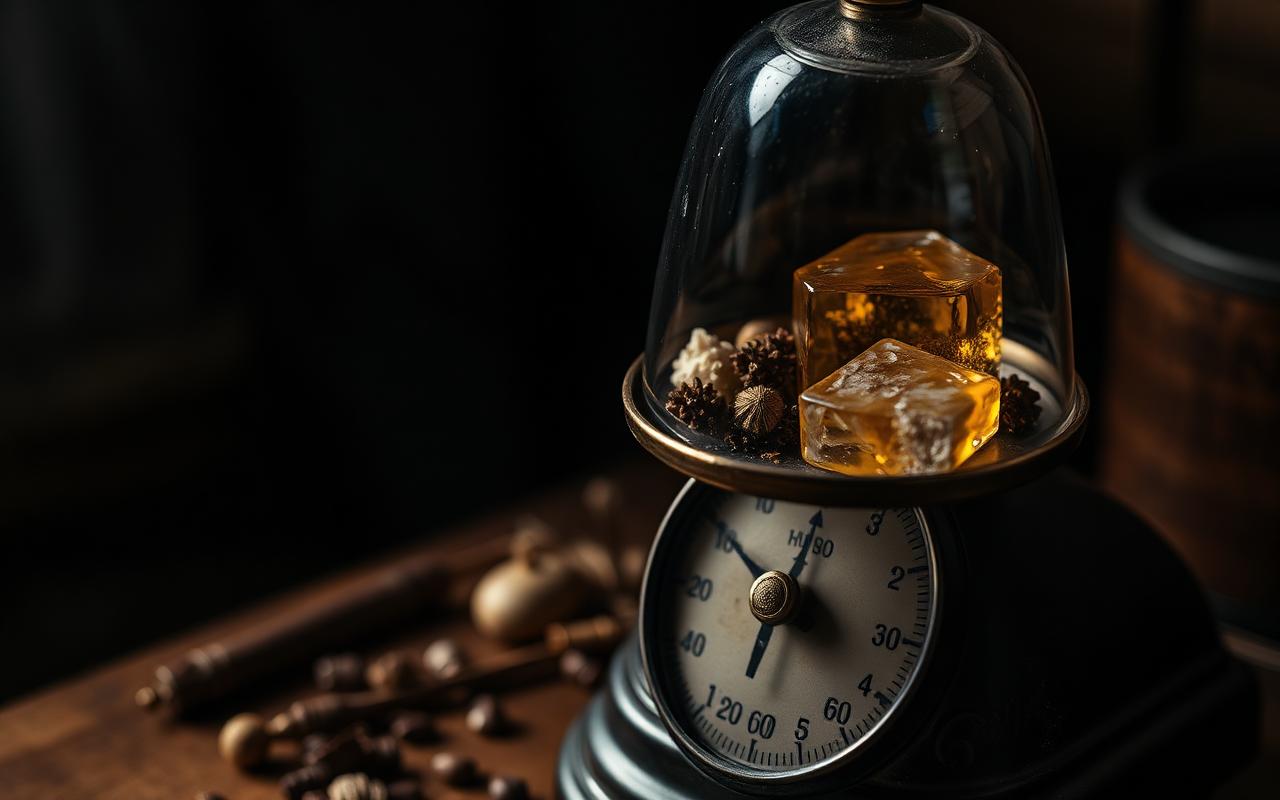
An apothecary scale is an honest object. It does not flatter. It does not approximate. It tells you exactly how much of a thing you have, and then it waits for you to decide whether that is enough. Almost everything we believe about how a small workshop should run, we learned by working under the gaze of one.
INHERITING A HABIT
When we set up the workshop, the first piece of equipment we acquired was not new. It was a brass beam scale from a closed pharmacy in upstate New York, the kind with a tray on each side and a marble base worn smooth by a century of mornings. We did not need it to be accurate to the milligram. Our digital scales handle that. We needed it to remind us, every time we walked past, that pouring candles is closer to compounding than to manufacturing. The pharmacist who used it for fifty years was making medicine. We are making something far less serious. But the posture is the same: a known quantity, a measured addition, a recorded result, a labeled product.
THE RATIO THAT MATTERS
Our pricing rule, vessel cost plus one dollar and eighty-five cents per ounce of wax, is itself an apothecary ratio. It is small, exact, and refuses to round. We chose it because we wanted the math to be visible. When you buy a candle from us, you are buying a vessel and a measured quantity of soy, and the price reflects both. There is no margin hidden in vagueness. The scale, in other words, is also an ethic. A pharmacist who fudged a measurement was committing a small kind of fraud, and so is a maker who waves vaguely at quality without showing the numbers behind it.
WHY SOY, SPECIFICALLY
Soy wax behaves differently from paraffin in ways that matter to a small pourer. It is forgiving of slow cooling. It accepts fragrance load up to about ten percent without weeping. It releases scent at lower temperatures, which suits a long evening burn. It is also, crucially, agricultural rather than petrochemical. We are not zealots about this. We simply prefer the way soy carries a scent: rounder, slower, less aggressive at the top, more present at the base. Paraffin throws harder and faster, which is why it dominates the candle aisle of any drugstore. We are not trying to compete with the drugstore. We are trying to make a candle that behaves like a long evening rather than a brief announcement.
ON COLORING, OR NOT
We do not add color to our wax. Every candle we pour is the soft natural cream of unpigmented soy. There are practical reasons for this, dyes can affect burn quality and complicate the wick choice, but the real reason is aesthetic. The vessel is the visual story. A brass cup, a cut-glass tumbler, a porcelain mustard pot. Coloring the wax inside it would be like painting over the patina on the brass. The natural soy reads as quiet, as serious, as deferential to the object holding it. That deference is the whole design.
THE POUR ITSELF
We pour at one hundred and thirty-five degrees Fahrenheit, give or take two degrees depending on the room. Cooler than that and the wax sets with a pebbled top. Warmer and the fragrance flashes off before the candle has even cured. Each vessel is weighed empty, filled to the calculated mark, then weighed again to confirm. Three numbers, every pour, recorded on a card that ships with the candle. The apothecary scale watches from the shelf. We pour in batches of six because that is how many vessels fit comfortably on our staging board, and because six is small enough that a single mistake doesn't ruin a day's work.
CURE TIME AND PATIENCE
A freshly poured candle is not yet a candle. It is wax with a wick in it. Soy needs at least seven days, and ideally fourteen, for the fragrance oils to fully bind to the wax matrix. Light a candle on day two and you'll get a weak, unbalanced throw. Light the same candle on day fourteen and the scent will fill a room. We do not ship candles before their tenth day. This costs us in inventory turnover and gains us in honest performance. The scale, again, has an opinion: a thing is not finished until it is finished, and rushing the cure is a different kind of fudge.
MEASURE AS RESPECT
We sometimes get asked why we do not simply pour to a line on the inside of the vessel and move on. The answer is that a line lies. Glass is uneven. Brass is uneven. The bottom of an antique cup is rarely flat. Weight does not lie. By weighing every pour we honor the specific vessel, not an idealized version of it. The candle that arrives at your door contains exactly what it claims to contain. That, more than any ingredient list, is what we mean by craft.
A SMALL INHERITANCE
The scale on our shelf will outlive us. It outlived the pharmacist who bought it new. It will outlive the workshop in its current form. We like that. We like working under the gaze of an instrument that has watched a lot of people try, and sometimes succeed, at being precise. It keeps the work humble, and humble work is the only kind worth doing for a long time.
THE NOTEBOOK
Every batch we pour is recorded by hand in a stitched notebook on the workbench. Date, room temperature, wax lot, fragrance lot, pour temperature, weight per vessel, observed cure issues, anything unusual. We have eleven such notebooks now, going back to the start of the workshop. They are not glamorous. They are the most valuable thing we own. When a customer writes in three years from now to ask why their candle smells slightly different from the one they bought last year, we can open the notebook and tell them. Usually the difference is fragrance lot. Occasionally it is room temperature on the day of pour. The notebook does not let us pretend the difference is imaginary. The notebook is the apothecary scale's literary cousin.
ON REFILLS, EVENTUALLY
We are working toward a refill program for our standard vessels, and the apothecary mind shapes how we are doing it. A refill will not be a generic puck of wax dropped into your spent vessel. It will be a measured pour, of the original scent, in the original ratio, calibrated to your specific vessel by weight. We are not in a hurry to launch this. The shipping logistics for molten or solid wax are nontrivial, and we want to get them right. When the program does launch, every refill will arrive with the same kind of card the original candle did: three numbers, hand-recorded. The scale, again, watching.
CLOSING
Apothecary practice is not nostalgic. It is a working method that happens to be old. The reason we keep working under it is that it produces honest objects, and honest objects are what we want our work to be. The brass scale on the shelf is not a decoration. It is the supervisor.